14 October 2025
*To be published on the New York City News Services’ Climate Correction site*
Reading Upton Sinclair’s The Jungle in middle school social studies was the reason that many moons ago, I decided at the ripe age of 14 to attempt vegetarianism. The descriptions of nails, fingers, and rat droppings being found in the meat and poultry products, coming out of a Chicago factory, and the lack of safety standards are tattooed forever in my mind. Though my vegetarianism attempt was a failure back then, the overall message of Sinclair’s work resonated and continues to resonate.

New York University.
Perhaps the social studies teacher, to not invoke fear in our young minds, decided to say ‘Well things aren’t like that anymore, we have the FDA.’ The truth of the matter is that things in the animal industrial complex have not changed. In fact, they might be worse than ever. But pioneers are putting forward fresh solutions, solutions that are innovative and rooted in indigeneity.
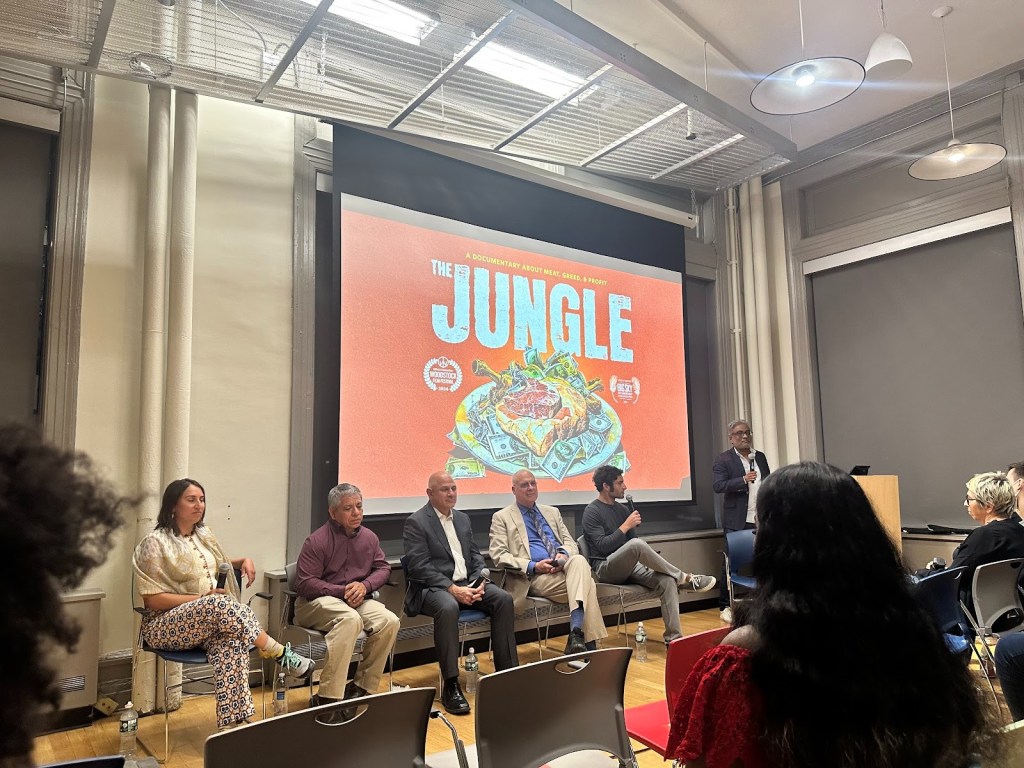
Recently, I attended a screening of the documentary The Jungle at New York University (NYU). Directed by Matt Wechsler, this film explores the history of the pork, chicken, and beef industries, the monopolization of said industries, the subsequent destruction of the planet from large-scale factory and industrial farming, and what’s being done to push back.
“From beef to pork to chicken, this industry is built on greed and exploitation,” said New York Times columnist Mark Bittman in the documentary. This is a big message of the film, and the focus is on how Americans want the meat industry out of sight and out of mind. With climate change, the meat industry is seemingly going back to its roots in the Upton Sinclair era, combining greed, exploitation, and poor farming practices while selling to the American people that we have the biggest and best thing when it comes to meat and poultry.
The documentary does a really good job at explaining the history of the animal product industry because to understand how we’ve gotten to where we are today, we need to understand who controls everything. The Packers and Stockyards Act was a federal law passed in 1921 that regulated the meat, poultry, and livestock industries to ensure fair trade practices and protect farmers, ranchers and consumers. Something that is tangentially lost today because we have four big companies, Tyson, JBL, Cargill and National Beef, monopolizing the industry.
Finally, a documentary not rooted in the health benefits of veganism—and I say this as someone who eats mostly vegetarian—because sometimes people do require animal products for health reasons. The question is, how can we keep the industries running on a large scale in the most ethical way possible for the animals, for the farmers, the factory workers, and the consumers, while mitigating negative effects to a planet bogged down by climate change?
An important and underrepresented aspect of the documentary is showing the dichotomy and innovation between the Jackson Family, who run their own farm in Durham, North Carolina, coupled with raising their own livestock and animals. They mention not having any sick animals versus a hog farmer interviewed named Chuck Wirtz, who figures out which one of his pigs is sick by looking at which one is not like the rest.
There is also a large discussion around the treatment of factory workers, which in some ways felt out of place within the larger messaging of the documentar,y but nonetheless extremely timely and important. In 2024, Tyson shut down its plant in Waterloo, Iowa, leaving nearly 1200-1300 people without jobs, and a few people interviewed in the documentary discussed having health issues like carpal tunnel syndrome. It raises a separate question of who takes responsibility for the people working in poor conditions in the factories, largely unseen by the American public.
Big companies like Tyson and Purdue have not only monopolized the meat and poultry industries, but they have also reshaped the treatment of animals and the rural American economy. 92% of hog farms disappeared in 20 years, with consolidation playing a key role and larger farms taking over the production of smaller ones. ⅕ of greenhouse gases are generated by livestock production which, is more than transportation. This, in turn, has reshaped the land. The land used to raise and feed livestock has lost its ability to sustain life; it relies on groundwater that is almost depleted and chemical pesticides and fertilizers. An industry built on greed that has, at its essence, gone back to its roots.
“The food system as it’s organized right now is almost all about profit,” Bittman said. After Tyson bought out the International Beef Plant (IBP) in 2001, former President Obama tried to reform the industry, but it was ultimately a failure. A reform giving the aptly named government division– Grain, Inspection, Packers and Stockyards Administration (GIPSA)–would have given authority to crack down on the power large corporate meatpackers hold over mid-size ranchers. This didn’t pass, and the industry remains monopolistic to this day.
Veganism, which many tout as an end-all solution for climate change, has problems in the industrial production of vegan products. These issues persist, especially if agriculture remains industrialized, it’s fueling climate change and limiting resources. Some of the worst environmental offenders other than meat include fruits and vegetables such as avocados, almonds, and cashews, which guzzle up gallons of water.
My favorite aspect of this documentary was an extensive look at the farmers reconnecting with their indigenous roots through restorative farming practices. Reginaldo Haslet Maroquin, founder of the Regenerative Agriculture Alliance, was interviewed and spoke greatly of this practice.
“The agriculture industry was never intended to nurture people, it was for money,” he said during the panel discussion.
Also known as regenerative agriculture, this aims to focus on the health of the soil, which has been overwhelmingly degraded by the use of heavy machinery, pesticide,s and fertilizers according to the World Economic Forum. Going back to indigenous farming roots and replicating the evolutionary system of the chicken is better for the animal and the entire business itself, it aims to replicate the planet’s ecosystem, so in this way every species, whether it’s fungi in the soil or the chickens themselves, takes care of one another. In Asia, where there are many rice farms, farmers use ducks as a natural way to fertilize soil and remove pests.
While regenerative agriculture is an extremely innovative and important solution to the present issue of climate change and modern agricultural practices, the problem remains that if we don’t have a government that will step in to help subsidize the practice, then it likely won’t be a big enough solution. New York certainly is one of the states taking large steps in the right direction with plant-powered Fridays, where vegan meals are served in schools. In the grand scheme of things, the documentary shows the history of the animal-product industrial complex and great solutions to the problem.
“What needs to change that hasn’t changed is policy,” Bittman said during the panel.
If we can continue to press forward on these solutions like regenerative agriculture and put pressure on lawmakers, we might be able to starve off climate change and keep the planet healthy for the next generation.
“The message of this film is to form an agricultural system that sustains generations,” Wechsler said during a panel after the screening.
 BLOG IT BABY