1 March 2022
***This piece is being published in an upcoming issue of VERVE Magazine***

There might be spoilers so read if you dare.
A wise person once said that Universal Studio’s Dracula from 1931 is campy. I did not expect it to be this campy and by campy it is the standards that we have for movies in 2022 that would have been seen as absolutely revolutionary in 1931. Or by campy we can go with Susan Sontag’s definition from her 1964 essay Notes on Camp: “the essence of camp is a love of the unnatural: of artifice and exaggeration.” This is meant to demonstrate camp by our own standards when watching this film, not the reactions of horror it garnered in the 1930s when it was released. For context when this film was released during the depression era, it was part of Universal Studios adaptations or anything they could get the rights to on the fly and for little money.
Directed by Tod Browning and produced by Carl Lemme Jr, Dracula follows Count Dracula (Bela Lugosi) who makes a real estate deal with and hypnotizes Renfield (Dwight Frye). He then travels to London and begins to wreak havoc eventually setting sights on Mina Harker (Helen Chandler) whose father Van Helsing (Edward Van Sloan) is a famed doctor and vampire hunter recruited to put a stop to the Count’s antics. Mina also has a best friend named Lucy Westenra (Frances Dade) who eventually dies because of Dracula’s vampirism but she’s never brought up again outside of being the mythical woman in white.
In any case, back to the important things, I decided I will simply find a free copy online since none of the millions of streaming services had it available without a premium. Upon playing, the music, a symphony from Swan Lake, faded out after the opening credits. I figured there was going to be a transition into more music but then again this was a film introduced in the early stages of ‘talkies.’ However that fact never crossed my mind and the music never came. I thought it was because this free copy of the film was likely a bootleg and thus coughed up $4 to Jeff Bezos on Amazon only to find that this subsequent ‘normal’ copy did not have music either. (This film has, in recent years, been re-released with a score by Philip Glass although I could not find this copy). The result was that when Count Dracula, played to exaggerated perfection by Bela Lugosi whom I absolutely adore, pulls his cape over his face in a delayed cut on action, all you hear is a swoosh sound and static background noise.
Quite frankly in a moment of dramaticism like this one that was meant to exude horror and repulsion amongst its audience, I laughed, and then I had to once again remind myself that yes I am watching a horror movie. The shot-reverse-shots between Dracula and Renfield (Dwight Frye) are once again laughable but in those moments of being horrific, they are a reminder of why this movie remains a fan favorite and a classic. The shadow cast over the Count’s face as he towers in a position of power over a sitting Renfield show Dracula’s increasing thirst for blood by virtue of being a vampire, and perhaps to some degree, this shows his desperation.
Additionally, the paradoxical vastness and claustrophobia of the room in his castle, which appears to be shot at a wider angle, shows that though Dracula has much of the control over the situation, what he does have is beginning to slip. In addition, the objects within the main dining/bedroom of the castle are mostly positioned off-center adding to that further sense of disconnect in what is an effective manner of making an audience feel disoriented. Dracula has the power of hypnosis and does hypnotize Renfield so this camera work is likely to make that apparent to an audience who might have not read the novel. Of course, this idea and subtext are more present in the 1897 novel by Bram Stoker but it is an interesting one nonetheless. The shadow play is a little overplayed but it’s really well done and I love how it makes Bela Lugosi look menacing and emphasizes his facial expressions. The objects within the castle (including Dracula) always seem to be bigger and towering over Renfield specifically.
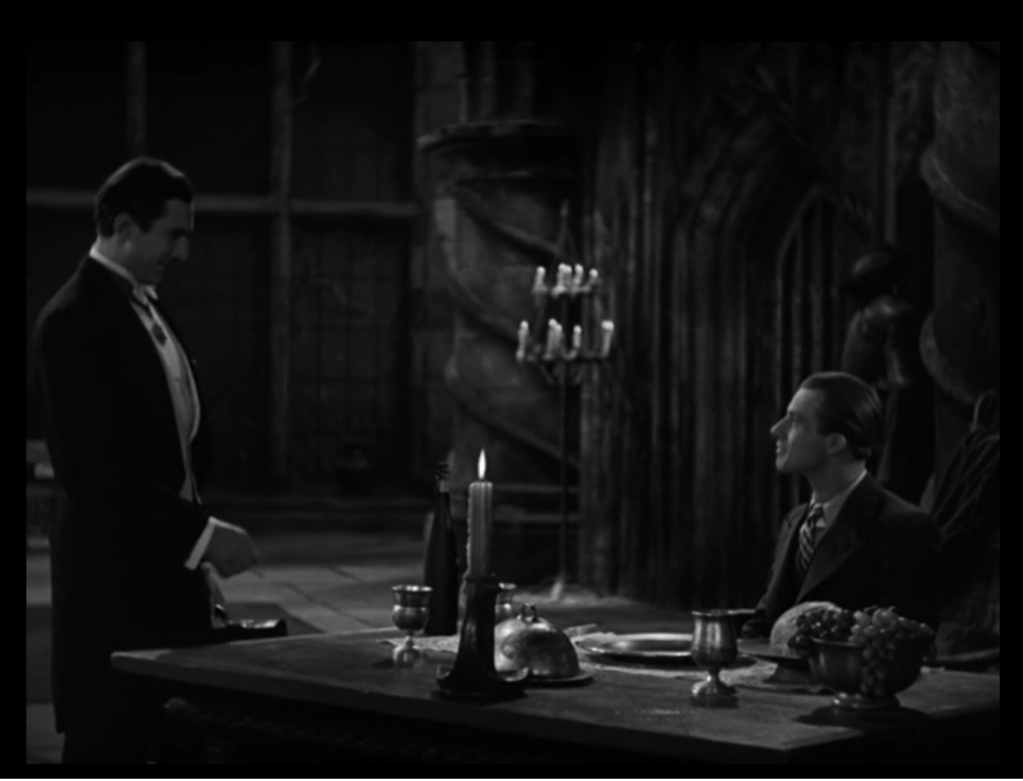
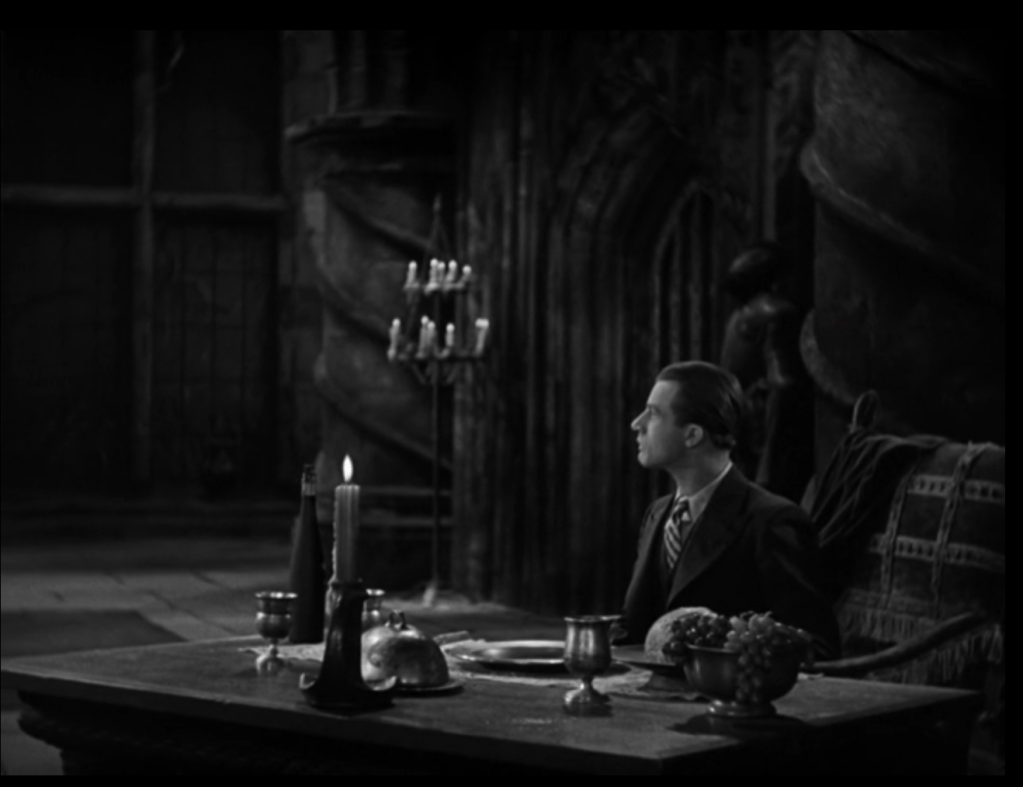

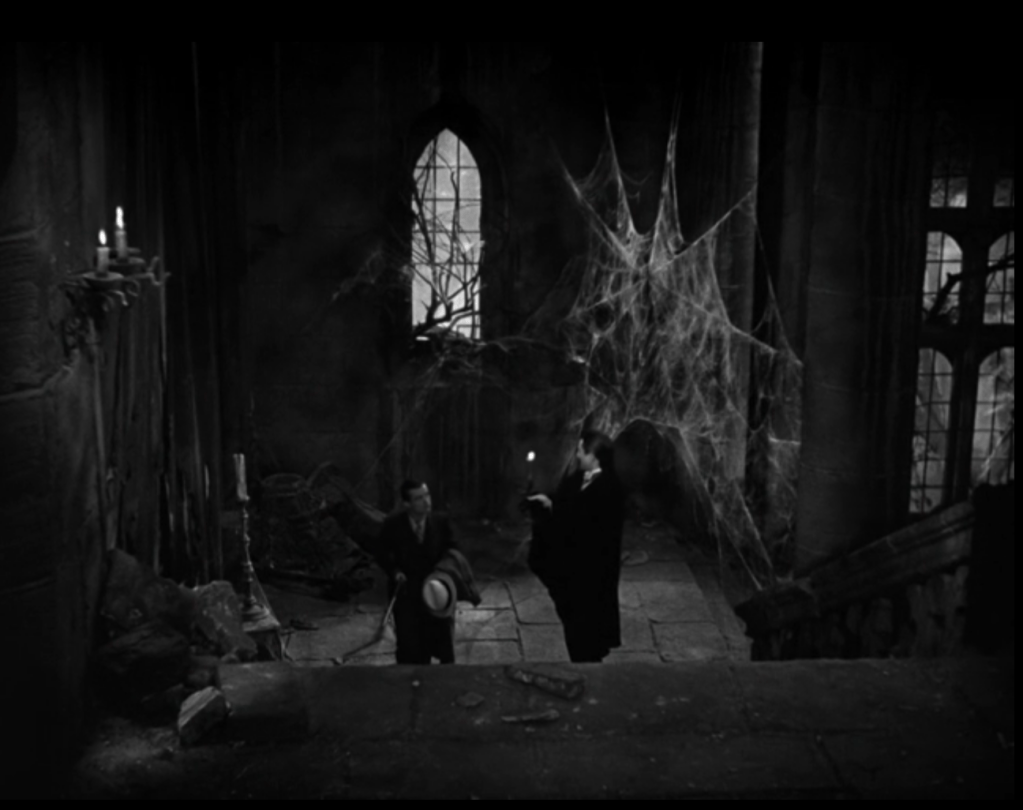
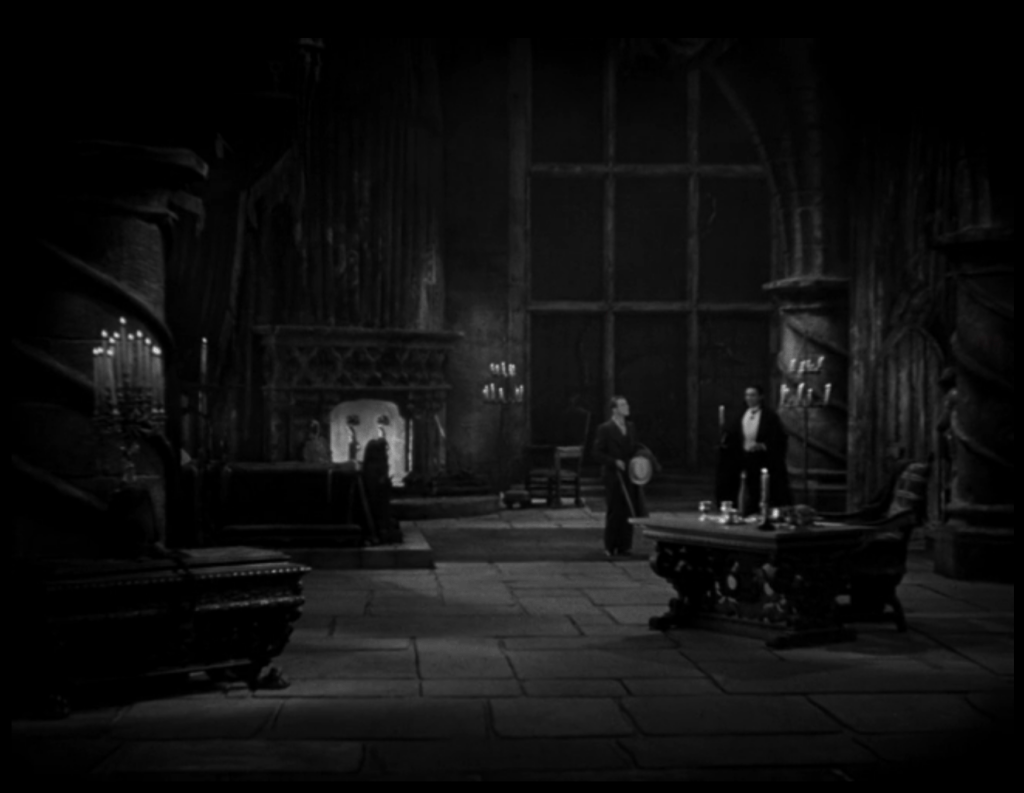

Our main heroine Mina Harker is an interesting one. When she gets hypnotized by Dracula, she acts robotic whereas Renfield acts deranged and begins to eat bugs. Nobody including her father Dr. Van Helsing, and her fiance Jonathan (David Manners) seem to notice up until Van Helsing opens a jewelry box and notices Dracula’s (delayed) flinch and lack of reflection in the mirror. It takes two or three moments like this, one involving the aforementioned delayed cloak reaction and a cross before words are put into action in stopping Dracula.
I think there is an interesting subtext where Dracula could be read as being bisexual or gay and given that this film was made pre-PCA (Production Code Administration) Code and pre-Paramount decision (referring to the 1948 Supreme Court case US v. Paramount). There would not have been a lot of restrictions in getting the movie passed by anything since studios controlled their distributions, actors, and, theatres at the time. The theatrical poster literally says “the story of the strangest passion the world has ever known” with Dracula chasing Renfield. Of course, I could write an entire piece on this subject alone so will just leave it here for the moment.
There are moments where once again the lack of sound is so apparent that one can hear the echoey nature of the set that it was filmed on. This is towards the end when Renfield falls, more like throws himself down, a flight of spiral stairs, and the camera is positioned so far back it is easy to see where the set starts and ends. I am not sure if this is meant to be slapstick, it was probably not considered to be so in the 1930s, but it was very exaggerated and for whatever reason, it felt relatable. Building off of that, there are plenty of meme-able moments. Yes, we are bringing memes into this. I felt that the delayed cuts on action, as previously mentioned, and the delayed reactions, in general, were some of the funniest and honestly why I love this movie so much and why you should watch it. I should also mention the amazing bat special effect (it looks like a puppet so it probably is some sort of dolley puppet), kudos to the props and SFX teams on that front.

Of course, some are going to lament its slowness and special effects but they fail to remember that if it was not for the success of this movie we would not have Frankestein (1931), The Wolf Man, The Mummy, The Invisible Man. Dracula ushered in a new era of horror and allowed horror movies to evolve into what they are today. The budget was just under $350k and ushered in $700k at the box office which is absolutely insane to think about when studios and people, in general, were struggling so badly.
In any case, you have presumably made it to the end. So I request that you watch the dang movie before making judgments just because it’s 91 years old, colorless, and music-less. You might be surprised. And frightened.

 BLOG IT BABY